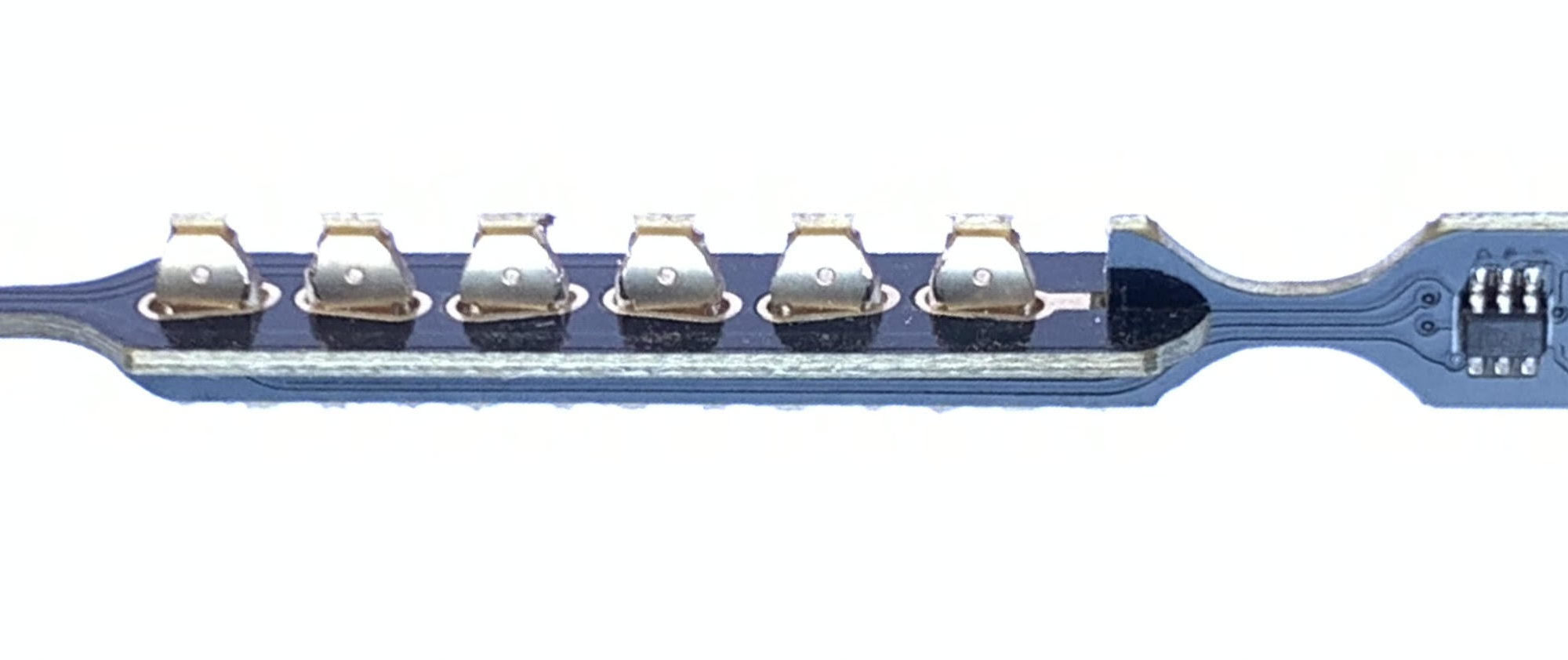
EESA’s Stijn Wielandt has developed a compact, robust, and low-cost method for interconnecting printed circuit boards (PCBs) without requiring soldering or additional components. https://ipo.lbl.gov/lawrence-berkeley-national-laboratory-introduces-printed-circuit-boards-with-solderless-board-in-board-interconnections-for-low-cost-flexible-designs/
Molecular Hijacking of a MicroRNA by the Hepatitis C Virus
Using the ALS, researchers found that a particular microRNA protects the hepatitis C virus from the body’s immune response. Instead of destabilizing viral reproduction, the microRNA unexpectedly helps stabilize it. https://als.lbl.gov/molecular-hijacking-of-a-microrna-by-the-hepatitis-c-virus/
CUORE Team Places New Limits on the Bizarre Behavior of Neutrinos
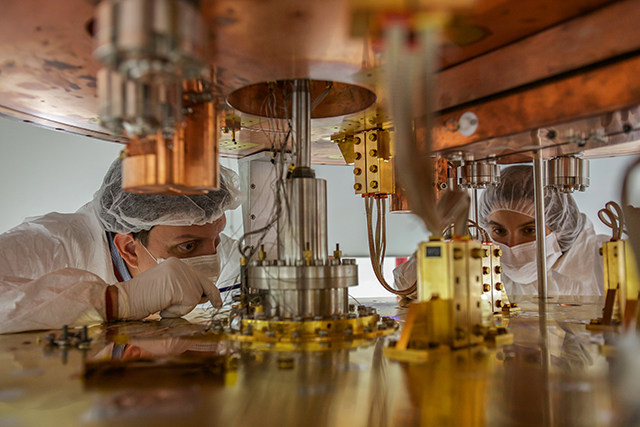
Physicists are closing in on the true nature of the neutrino. CUORE’s limits on the behavior of these tiny phantoms are a crucial part of the search for the next breakthrough in particle and nuclear physics – and the search for our own origins. https://newscenter.lbl.gov/2022/04/06/cuore-team-places-new-limits-on-the-bizarre-behavior-of-neutrinos/
What Drives Electron–Hole Asymmetry in Graphene?
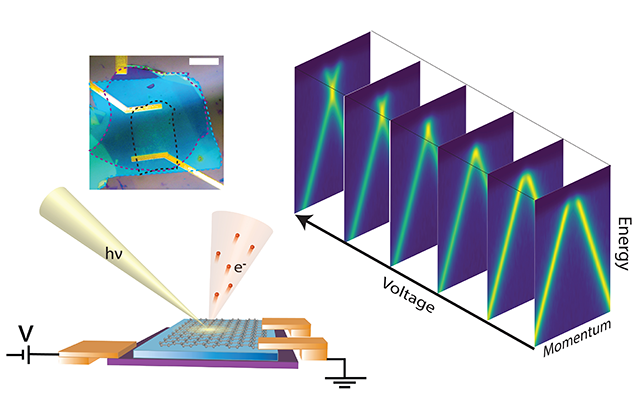
Researchers using the Advanced Light Source (ALS) developed a better understanding of electron–hole asymmetry that could lead to materials that achieve unconventional superconductivity and other new material functions. This could lead to smaller, faster, more energy-efficient devices. https://als.lbl.gov/what-drives-electron-hole-asymmetry-in-graphene/
Lab Researchers Contribute to Report on Climate Change
Lab researchers contributed to chapters on industry and mitigation pathways in the Intergovernmental Panel on Climate Change’s (IPCC’s) Sixth Assessment Report. The report calls for aggressive and comprehensive actions to try to achieve net-zero greenhouse gas emissions by mid-century. https://newscenter.lbl.gov/2022/04/04/achieving-climate-goals-will-require-transformational-changes/
Lab Scientists Develop New Method for Measuring Carbon in Soil
Scientists at the Lab have developed a new way to take a census of carbon in the ground under our feet – a crucial tool for managing climate change. This new technique makes it possible to see the carbon in the dirt without digging holes or taking soil samples, like an X-ray for the soil. https://newscenter.lbl.gov/2022/03/31/berkeley-lab-team-hunts-for-carbon-in-soil-without-getting-their-hands-dirty/
The Agile BioFoundry: From LDRD Project to Leading Public Biofoundry
The Agile BioFoundry first started as an LDRD project eight years ago. Today, it involves seven national labs and more than 70 researchers working in collaboration with industry and academia to accelerate innovation and develop new biomanufacturing methods. Read about its road to success. https://research.lbl.gov/2022/03/28/the-agile-biofoundry-from-ldrd-project-to-leading-public-biofoundry/
Lab Computing Resources Enable Deeper Understanding of Supernovae Explosions
Astrophysics researchers recently recorded the earliest post-explosion detection of a thermonuclear explosion of white dwarf stars. They used cosmological models developed by scientists at the Lab and supercomputing resources at the National Energy Research Scientific Computing Center (NERSC). https://www.nersc.gov/news-publications/nersc-news/science-news/2022/berkeley-lab-computing-resources-enable-deeper-understanding-of-supernovae-explosions/
New Energy Storage Virtual Field Trip Seminar Series
Berkeley Lab’s Energy Storage Center & SLAC National Accelerator Laboratory launched a series exploring the sometimes surprising role energy storage plays in the world around us. Check out the first episode, a virtual field trip to the International Space Station. https://energystorage.lbl.gov/field-trip/
Machine Learning by the Lab Used to Predict Watershed Behavior
Due to drought, wildfires, and floods, practitioners can no longer depend on historical trends to project how watersheds will behave in future years. The Watershed Function Scientific Focus Area led by the Lab uses machine learning to characterize entire watersheds. https://eesa.lbl.gov/new-research-demonstrates-method-for-rapidly-characterizing-watershed-organization-and-function-using-zone-based-approach/