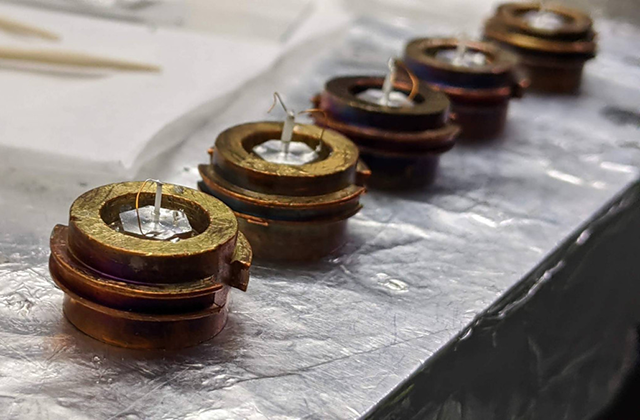
Unconventional superconductors carry electrical current with zero resistance in ways that defy our previous understanding of physics. A recent study led by Berkeley Lab could help researchers advance future applications in next-gen energy storage, supercomputing, and magnetic levitating trains. https://newscenter.lbl.gov/2022/03/24/exotic-superconductors-superpowers/
A Laser-Powered Upgrade to Cancer Treatment
Biologists and physicists at the Lab have teamed up to create new opportunities for cancer treatment using laser-generated proton beams. The new research venture pairs cutting-edge particle accelerator science and radiation therapy. https://newscenter.lbl.gov/2022/03/23/laser-proton-cancer-treatment/
New Lab Tools for Biosciences
The Lab has launched a digital brochure with 16 open and closed source software and tools for imaging, omics, and synthetic biology research and development. These tools can accelerate discovery and hasten products-to-market in biosciences. https://www.businesswire.com/news/home/20220303005218/en/Lawrence-Berkeley-National-Laboratory-Offers-Software-Tools-for-Biosciences-Research-and-Development
Fungal Friends or Foes in Plant Roots
A recent international study on potential symbiotic partnerships between fungal microbes and plant roots was partially enabled by the Joint Genome Institute through a JGI Community Science Program (CSP) proposal. https://jgi.doe.gov/fungal-friends-or-foes-in-plant-roots/
Quantifying Photosynthesis with Increased Atmospheric CO2
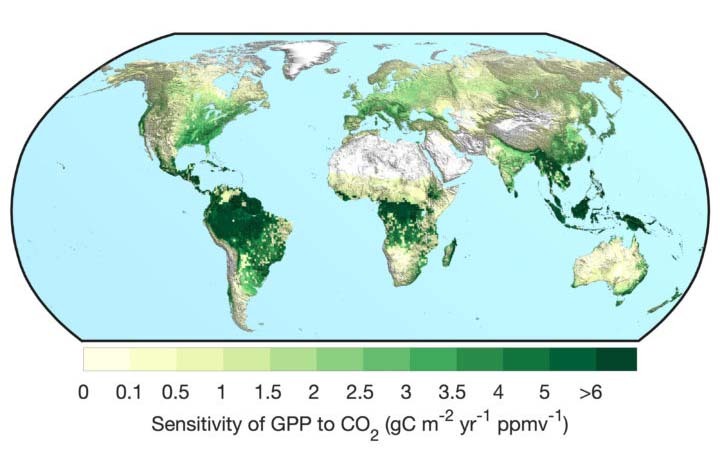
Plants have been shown to photosynthesize more with increased atmospheric levels of CO2, but the effect can be hard to determine. Lab researchers are reporting the first direct observational evidence of the impact CO2 has on increasing photosynthesis in natural environments. https://eesa.lbl.gov/eddy-fluxes-are-key-to-quantifying-how-much-more-plants-photosynthesize-with-increased-atmospheric-co2/
Dead or Alive? Modeling the Global Carbon Cycle
Whether dead or alive, soil microorganisms play a major role in the cycling of carbon in the biosphere. A new review appearing in Nature Reviews Microbiology outlines how it is now possible to predict how the life and death of soil microbes may impact the planet’s soil carbon stocks. https://eesa.lbl.gov/dead-or-alive-modeling-how-microorganisms-in-soil-shape-the-global-carbon-cycle/
JGI Researcher Helps Develop Plant Root Atlas
Benjamin Cole, a research scientist at the Joint Genome Institute (JGI), is co-author of a study that mapped gene expression patterns in specific plants. This plant root atlas could help researchers track cell development and how they determine identity. https://jgi.doe.gov/plant-root-atlas-for-tracking-developmental-trajectories/
Climate Simulations Redefine North American Monsoon Causes
On average, western Mexico and the American Southwest receive half their rainfall for the year between July and September. The deluge is due to the weather pattern known as a monsoon – but new analysis shows that this monsoon is like none other on Earth. https://cs.lbl.gov/news-media/news/2022/climate-simulations
How Can X-Rays Make Better Batteries?
ALS senior staff scientist David Shapiro and Stanford materials science professor William Chueh share how their pioneering X-ray techniques can help researchers understand how battery materials work in real time at the atomic scale. Click here to read the Q&A with Chueh and Shapiro. https://newscenter.lbl.gov/2022/03/04/how-x-rays-make-better-batteries/
New Software Leverages Prediction Uncertainty to Optimize Deep Learning Models
A team of Berkeley Lab researchers has developed HYPPO, an open-source software tool for hyperparameter optimization of deep neural networks used in scientific research. HYPPO leverages prediction uncertainty to optimize deep learning models for science. Click here to learn more. https://cs.lbl.gov/news-media/news/2022/hyppo-leveraging-prediction-uncertainty-to-optimize-deep-learning-models-for-science/