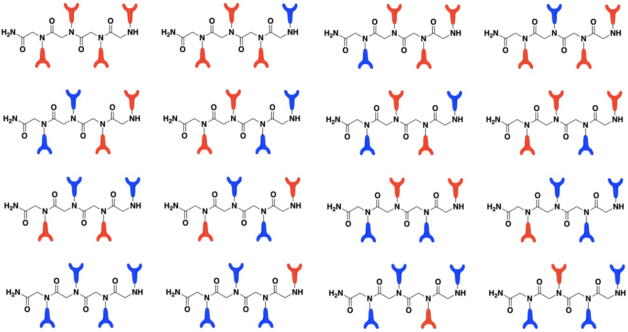
A team led by Berkeley Lab has developed a library of artificial proteins that bind to the heavy metals that make up the so-called f-block elements at the bottom of the periodic table. The new library offers researchers an automated, high-throughput method for precisely designing new peptoids. https://newscenter.lbl.gov/2019/12/23/artificial-proteins-grasp-on-metal/
Videos Highlight Hydrogen Research Collaborations
Two new videos highlighting ongoing collaboration and innovative research advancements promoting hydrogen as a large-scale renewable energy resource have recently been completed by a consortium of national laboratories, including research scientists from Berkeley Lab. https://energyconversiongroup.lbl.gov/videos
Unique Cancer Drug Begins Historic Clinical Trial
AMG 510 is the first drug to reach clinical trials that inhibits mutant KRAS proteins, which are among the most common causes of cancer. Researchers from Amgen, the company that developed the therapy, used X-ray crystallography at the Advanced Light Source to better understand the KRAS molecule. https://newscenter.lbl.gov/2019/12/23/cancer-drug-begins-clinical-trial/
SLAM Friday: Tess Smidt
Every Friday in a feature series in Elements, meet one of the 12 early career Lab scientists who competed in the 2019 SLAM pitch contest. This week, watch and read Tess Smidt’s pitch on “Master of Atoms.” https://slam.lbl.gov/2019-slam/2019-finalists/tess-smidt
Twas the Night Before the Periodic Table
As we close out our yearlong celebration of the 150th anniversary of the periodic table, the Lab pays homage to Dmitri Mendeleev’s creation in this imagined reenactment of his nighttime epiphany, based on a true story. Happy holidays from Berkeley Lab. https://youtu.be/85El3aHWYvc
Lab’s Top 10 Science Stories of 2019
From the health benefits of cool roofs to an experiment to search for dark matter, Berkeley Lab researchers did a lot of science in 2019. The top stories range from a new way to recycle plastic to spearheading a once-in-a-generation investment in water-treatment technologies. https://newscenter.lbl.gov/2019/12/16/berkeley-labs-top-10-science-stories-of-2019/
Murayama Featured in Discover Story on Dark Matter
The race to discover dark matter has vexed physicists since the 1930s. Several theories have emerged in this “dark matter derby,” which are highlighted in a recent Discover magazine article. The Lab’s Hitoshi Murayama puts his money on Strongly Interacting Massive Particles, or SIMPs. https://www.discovermagazine.com/the-sciences/what-is-dark-matter-made-of-these-are-the-top-candidates
Lab to Host InnovationXLab Biomanufacturing Summit
Berkeley Lab is hosting the InnovationXLab Biomanufacturing summit Jan. 28 – 29 at Cal Memorial Stadium. This exclusive event, DOE’s fifth InnovationXLab, will showcase how U.S. industry can leverage the world-leading bioscience capabilities of the national laboratories. https://xlabbiomanufacturing.lbl.gov/
Reconstructing a Neutron Star Merger
A team led by scientists that included Berkeley Lab researchers has simulated the formation of a disc of matter, a giant burst of ejected matter, and the startup of energetic jets in the aftermath of a merger by two neutron stars. https://newscenter.lbl.gov/2019/12/12/simulations-attempt-to-reconstruct-one-of-the-most-explosive-events-in-the-universe-a-neutron-star-merger/
Tiny Sensors Watch Materials Transform Under Pressure
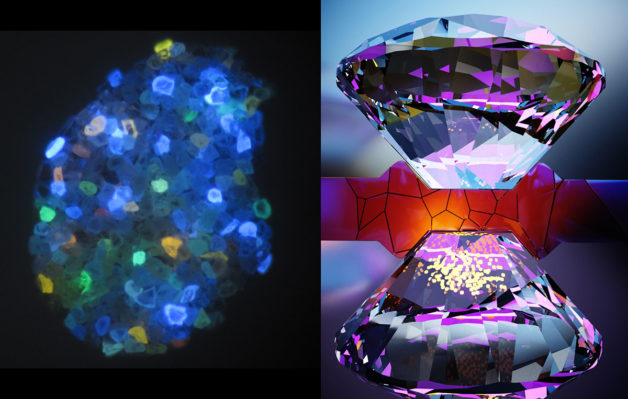
A team of scientists led by Berkeley Lab has transformed diamonds’ natural atomic flaws into an ultrasensitive diamond anvil sensor that could open the door to a new generation of smart, designer materials, as well as the synthesis of new chemical compounds, atomically fine-tuned by pressure. https://newscenter.lbl.gov/2019/12/12/sensor-materials-under-pressure/