X-ray scattering experiments at the ALS helped reveal how nanosized crystals (“quantum dots”) self-assemble and fuse to form “supercrystals,” which could aid the creation of high-performance, low-cost electronic materials for photovoltaic and photon-sensing applications. https://als.lbl.gov/the-choreography-of-quantum-dot-fusion/
Fishing for Novel Cellulose Degraders
JGI researchers developed a function-driven, single-cell screen — a “hook and bait” approach — to isolate cellulose-degrading microbes. This new technique sheds light on the diversity of microbial enzymes, which could have a plethora of potential applications to industrial processes. https://jgi.doe.gov/fishing-for-novel-cellulose-degraders/
SLAM Friday: Wenhao Sun
The Friday SLAM series comes to end today with Wenhao Sun, who won the Lab’s early career and postdoc pitch contest last September. Watch and read his pitch on “Mapping Uncharted Chemical Spaces.” https://slam.lbl.gov/2019-slam/2019-finalists/wenhao-sun
Maxon Serves on ‘Safeguarding Bioeconomy’ Committee
The National Academy of Sciences, Engineering, and Medicine (NASEM) has issued a report, “Safeguarding the Bioeconomy,” which quantifies the financial impact of and the challenges faced by the U.S. bioeconomy. The Lab’s Mary Maxon served on the NASEM committee that produced the report. https://biosciences.lbl.gov/2020/01/15/maxon-serves-on-the-nasem-safeguarding-the-bioeconomy-study-committee/
Machine Learning Helps Stabilize Synchrotron Light
Recent advances in synchrotron light-source technology will enable smaller beam sizes, requiring much tighter control over beam stability. Researchers at the ALS showed that machine learning can predict fluctuations in the size of beams generated by light sources, correcting them before they occur. https://als.lbl.gov/machine-learning-helps-stabilize-synchrotron-light/
Five Years In, FLEXLAB® Is Thriving
The 2019 fiscal year was one of the busiest yet for FLEXLAB, Berkeley Lab’s advanced integrated building and grid technologies testbed. The facility — which just marked its fifth year — conducted 17 projects over the past fiscal year, which together encompassed 127 weeks of testing. https://flexlab.lbl.gov/news/article/five-years-flexlab-thriving
Anomalous Orbital Structure in 2-D Materials
The relentless drive toward miniaturization of silicon-based electronics has ignited exhaustive research into a variety of 2-D layered materials. At the ALS, researchers explored how structural distortions in one such material results in an unexpectedly large splitting of valence electron states. https://als.lbl.gov/anomalous-orbital-structure-in-two-dimensional-materials/
Chris Fall to Testify Before House Science Committee
DOE Office of Science Director Chris Fall will testify before the U.S. House of Representative’s Subcommittee on Energy on Wednesday, Jan. 15, at 11 a.m. Pacific Time. His presentation on frontiers in energy research and discovery will be livestreamed. https://science.house.gov/hearings/the-department-of-energys-office-of-science-exploring-the-next-frontiers-in-energy-research-and-scientific-discovery?utm_medium=email&utm_source=FYI&dm_i=1ZJN,6OGTG,E29DCF,QN0LS,1
Lab’s Ritchie Featured in Science Friday Segment
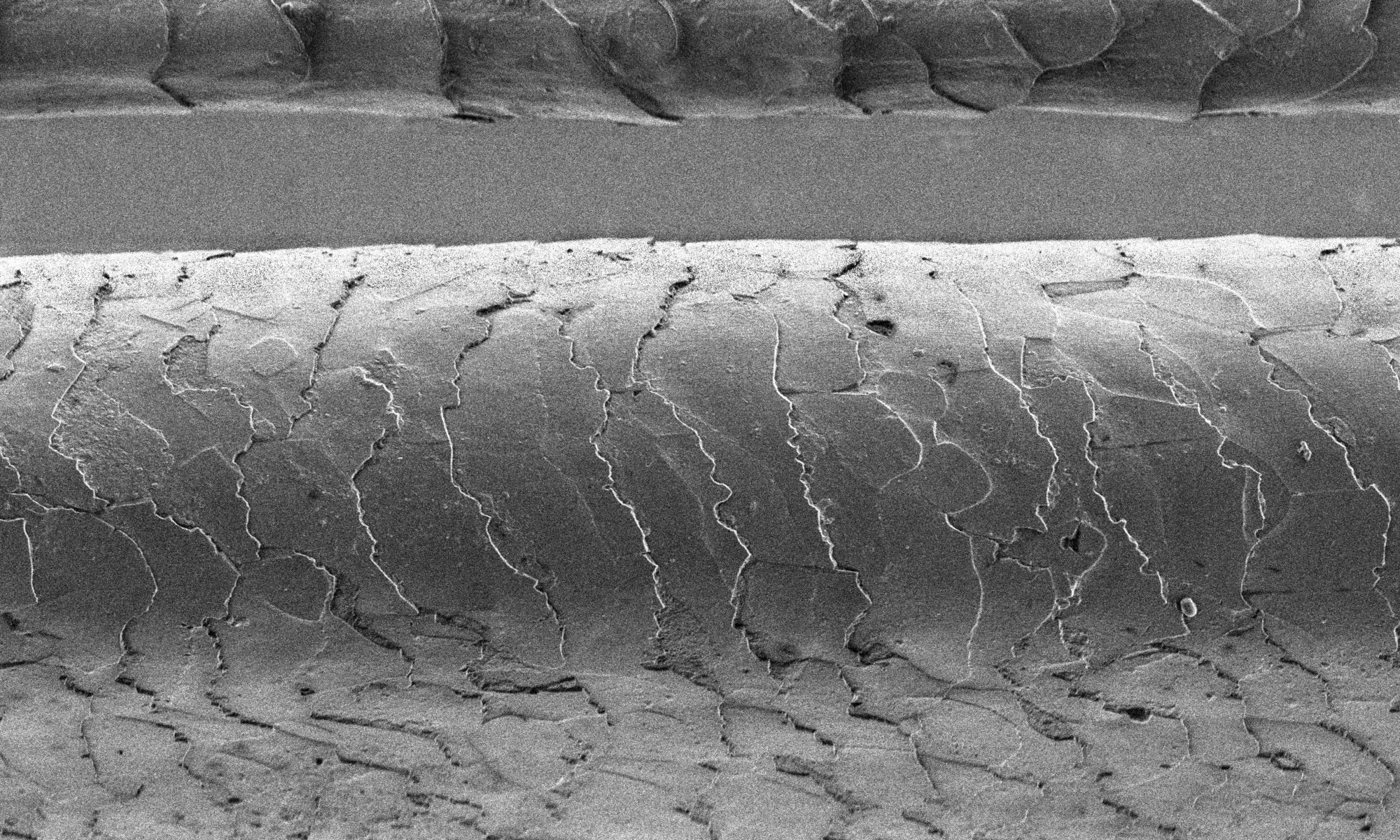
Did you know that when hair is stretched it’s stronger than steel? A team of scientists tested samples from eight different mammals, including humans, to see what gives hair its strength. Rob Ritchie discussed this research on a recent episode of public radio’s Science Friday. https://www.sciencefriday.com/segments/combing-over-what-makes-hair-so-strong/
Synthetic Proteins Can Filter Out Bad Molecules
Using resources at the ALS and Molecular Foundry, MSD’s Ting Xu has created a synthetic material that is as effective as naturally occurring proteins in transporting molecules through membranes, a major milestone that could transform water desalination, energy storage, and biofuels research. https://news.berkeley.edu/story_jump/lab-made-proteins-mimic-cellular-gatekeepers/