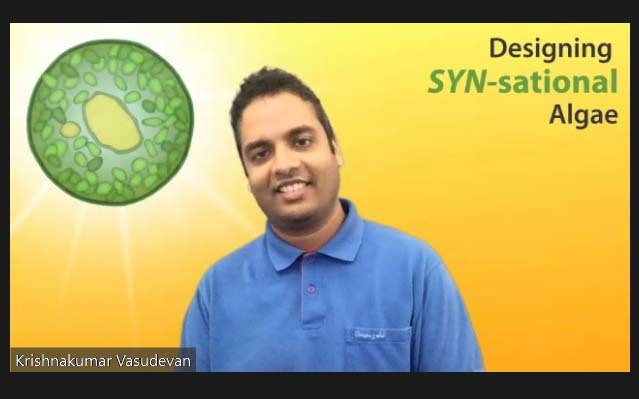
Every Friday in Elements meet one of the 12 early-career scientists who competed in the 2021 Research SLAM. Is algae the answer to the world’s renewable energy questions? Krishnakumar Vasudevan from JGI is excited to share how he uses “syn”sational algae as a living renewable energy source. https://slam.lbl.gov/2021-slam/2021-slam-finalists/krishnakumar-vasudevan
How AMReX is Influencing the Exascale Landscape
The software packages and frameworks that will support the demanding scientific applications that run on next-generation exascale computing systems are as important as the hardware. In this Q & A, Computing Science’s Andrew Myers discusses AMReX, a key software ecosystem developed at the Lab. https://cs.lbl.gov/news-media/news/2021/how-amrex-is-influencing-the-exascale-landscape/?ct=t(ITL_13_OCT_2021)&goal=0_6ff696e18a-48d0e8fa5b-213533002
When Timing Isn’t Everything: Spontaneous Chemical Dynamics
Like the emergence of a butterfly from its cocoon, most chemical reactions happen spontaneously, without control over exact timing. Using the ALS, a team led by researchers from the Chemical Sciences Division has made an important first step toward monitoring such processes. https://als.lbl.gov/when-timing-isnt-everything-spontaneous-chemical-dynamics/
Research Team Unlocks Paths to a Quantum Future
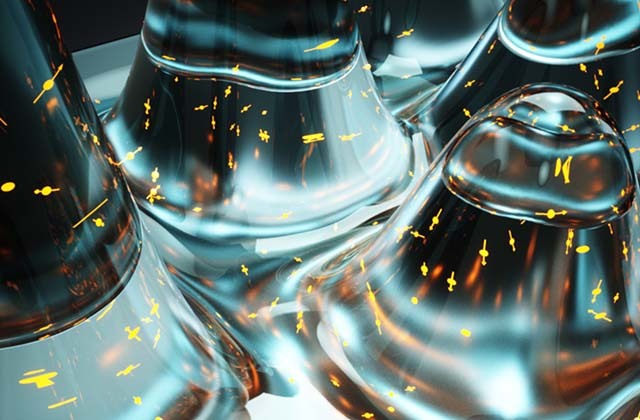
Researchers from the Lab’s Center for Novel Pathways to Quantum Coherence in Materials are developing new pathways to create and protect quantum coherence. Doing so will enable exquisitely sensitive measurement and information processing devices that function at ambient or even extreme conditions. https://newscenter.lbl.gov/2021/10/12/team-unlocks-quantum-future/
Deep Learning Tactics Speed Quantum Simulations
A Lab and UC Berkeley research team is using a deep learning technique — and a unique algorithm they developed — to optimize quantum simulations and speed the time it takes to create and test different quantum architecture designs. https://crd.lbl.gov/news-and-publications/news/2021/deep-learning-tactics-speed-quantum-simulations/
Lab Leads Transgender-inclusive Name Change Initiative
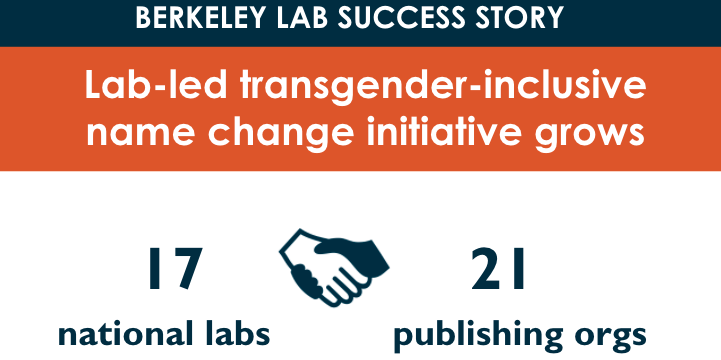
In a sea change for scientific publishing, a project led by Berkeley Lab has paved the way for researchers who change their names to retain recognition of their previously published work. Read about the initiative and how to initiate a name change request. https://research.lbl.gov/2021/10/06/inclusion-in-stem-lab-leads-transgender-inclusive-name-change-initiative/
Hydrogen Can Play Key Role in U.S. Decarbonization
It’s National Hydrogen and Fuel Cell Day. Hear more about how the Lab plays a leading role in the research and development of clean hydrogen, both on the fundamental science and applied technologies side, in this Q&A with Energy Technology Area’s Adam Weber and Ahmet Kusoglu. https://newscenter.lbl.gov/2021/10/08/hydrogen-can-play-key-role-in-u-s-decarbonization/
SLAM Friday: Lightsabers at the Nanoscale
In a new Elements feature on Fridays, meet one of the 12 early-career scientists who competed in the Lab’s 2021 Research SLAM. Yoseob Yoon from Materials Sciences is working to make real-life lightsabers! Find out how he harnesses the Force to make a better generation of computers. https://slam.lbl.gov/2021-slam/2021-slam-finalists/yoseob-yoon
Cell ‘Fingerprinting’ and Alzheimer’s Disease
A technology developed by Lab scientists shows great promise for diagnosing Alzheimer’s disease before symptoms arise, potentially changing the course of research and treatment for this condition, which affects millions of people worldwide. https://newscenter.lbl.gov/2021/10/06/skin-cell-alzheimers-test/
Enhancing Access to Experimental Data
ESnet and the Lab’s Computational Research Division are part of a team that has successfully demonstrated how in-network caching could dramatically improve the time it takes for scientists to reliably access and share experimental data. https://www.es.net/news-and-publications/esnet-news/2021/berkeley-lab-and-esnet-pioneer-in-network-caching-model/