Scientists at the Lab and the University of Massachusetts Amherst have demonstrated the first self-powered, aqueous robot that runs continuously without electricity. The technology has potential as an automated chemical synthesis or drug delivery system for pharmaceuticals. https://newscenter.lbl.gov/2021/12/08/liquid-robots-never-run-out/
Fiber Lasers Poised to Advance Development of Practical LPAs
Researchers in the Accelerator Technology and Applied Physics (ATAP) Division are taking on the next phase in the development of laser-plasma particle accelerators (LPAs) – potentially game-changing tools for research and practical applications. https://newscenter.lbl.gov/2021/12/06/fiber-lasers-poised-to-advance-berkeley-labs-development-of-practical-laser-plasma-accelerators/
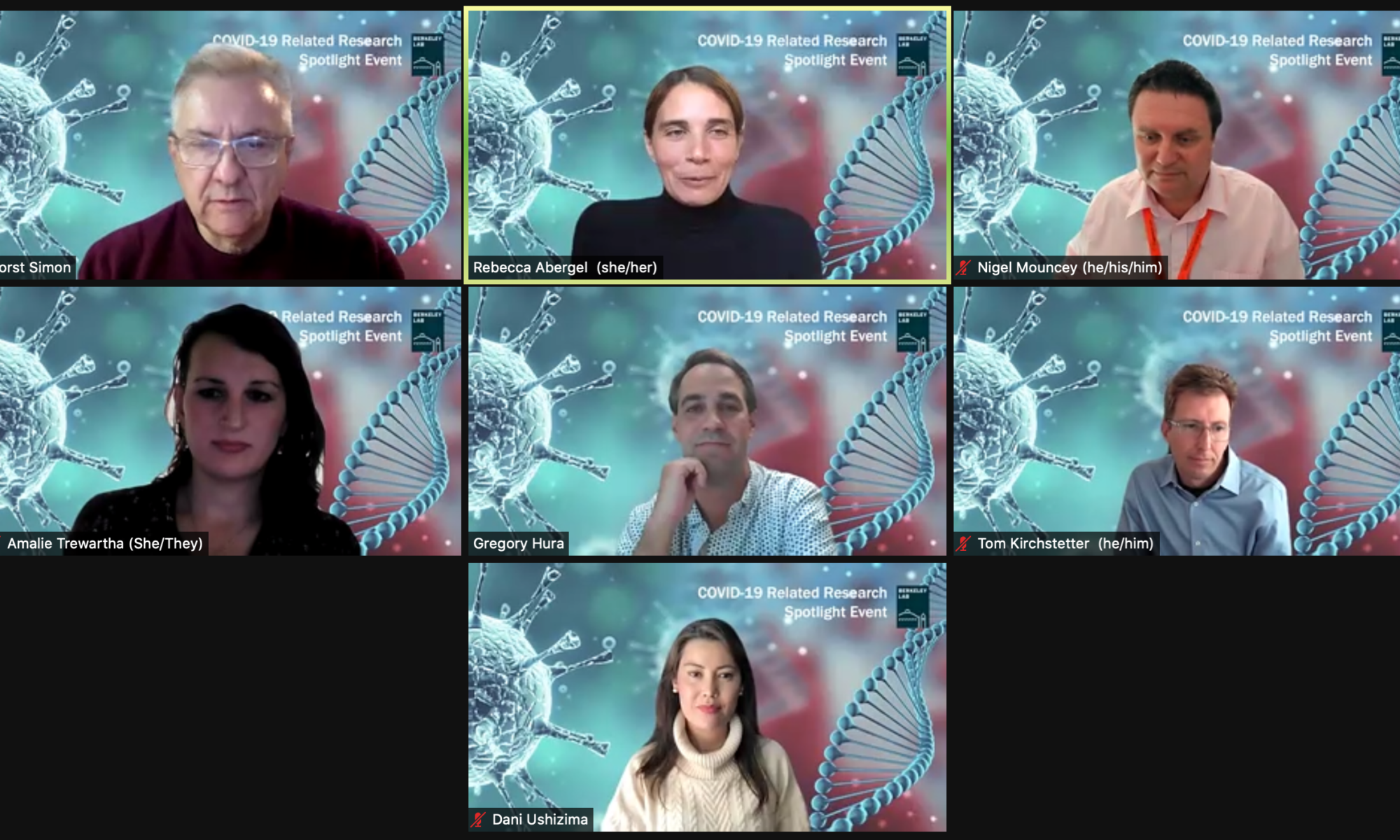
Video Replay: COVID-Related Research Spotlight Event
Many teams at the Lab contributed to COVID-related research to address the pandemic. Watch a replay of a recent panel discussion of the Lab’s efforts and accomplishments, featuring Rebecca Abergel, Greg Hura, Tom Kirchstetter, Nigel Mouncey, Amalie Trewartha, Dani Ushizima, and Horst Simon. https://streaming.lbl.gov/video-library
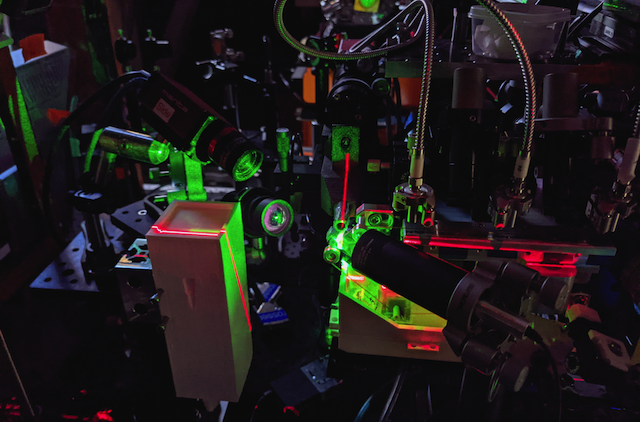
Chloro-phylling in the Answers to Big Questions
In this Q&A, we spoke to two Berkeley Lab scientists who investigate the atomic-level choreography of photosynthesis – the enzyme-driven cellular process fundamental to life on Earth. Check it out to learn about their latest milestones, shooting stuff with lasers, and why they chose this field. https://newscenter.lbl.gov/2021/11/30/chloro-phylling-in-the-answers/
AAAS Honors Lin Meng for Research on Tree Phenology and Climate Change
The American Association for the Advancement of Science awarded Lab post-doctoral researcher Lin Meng the 2021 Science & SciLifeLab Prize for Young Scientists for her unique study of how rising temperatures and artificial light can alter the regular day-night cycle that plants and trees use. https://www.aaas.org/news/warmer-brighter-cities-alter-urban-tree-leafing
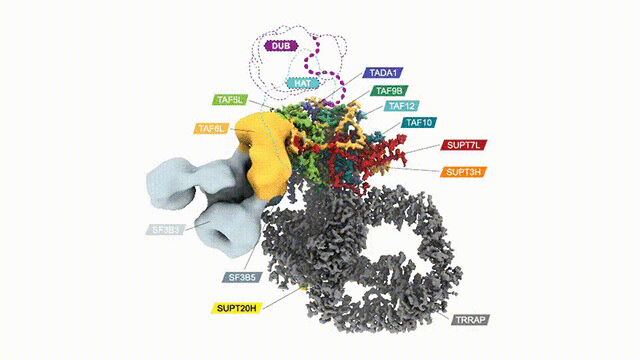
Structure of Human SAGA Protein Complex Solved
A team led by Eva Nogales, senior faculty scientist in the Biosciences Area, used cryo-electron microscopy to produce the first detailed 3-D structure of human SAGA, a 20-piece molecular machine that helps control gene activity and is crucial to life. https://biosciences.lbl.gov/2021/11/22/structure-of-human-saga-solved/
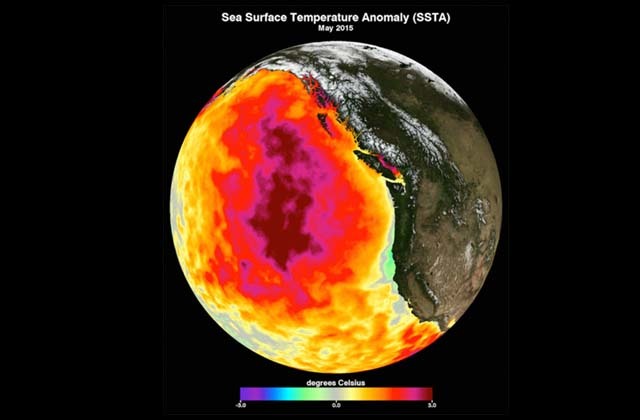
When ‘The Blob’ Made It Hotter Under the Water
“The Blob” is more than a cult horror film. It was also a large-scale marine heatwave that began in 2013 and grew to dominate the Pacific Ocean for three years. Researchers are using data generated by the Lab’s Joint Genome Institute to model the impact of these heatwave events. https://jgi.doe.gov/when-the-blob-made-it-hotter-under-the-water/
Q&A: How Can Next-Gen Computer Chips Reduce Our Carbon Footprint?
Berkeley Lab scientists Maurice Garcia-Sciveres and Ramamoorthy Ramesh discuss how they are designing new microchips that could perform better – and require less energy – than silicon, laying the foundation for next-gen computer chips that reduce our carbon footprint. https://newscenter.lbl.gov/2021/12/01/can-chips-reduce-carbon-footprint/
Sizing Up the Challenges in Extracting Lithium from Geothermal Brine
As part of a recently published review, Lab scientists assessed the technology landscape for developing a domestic source of lithium. One of the primary focuses is California’s Salton Sea, where geothermal brine pumped out as part of energy production could become a major source of domestic lithium. https://newscenter.lbl.gov/2021/11/29/sizing-up-the-challenges-in-extracting-lithium-from-geothermal-brine/
Marine Microbe Contains Multitudes
The bacterium SAR324 is unusually cosmopolitan in that it can be found thriving at multiple ocean levels. Researchers at the Joint Genome Institute are studying SAR324 to help unlock how marine microbes affect carbon fluxes in the environment. https://jgi.doe.gov/marine-microbe-contains-multitudes/