Employing existing libraries, scientists from Baylor College of Medicine identified several molecules that would target a pivotal protease in SARS-CoV-2 propagation. Efforts to determine more about the candidates were assisted by the X-ray crystallography data collected at the Advanced Light Source. https://biosciences.lbl.gov/2021/11/01/bcsb-determines-interactions-potential-inhibitor-sars-cov-2-protease/
New Technique Gets the Drop On Enzyme Reactions
Researchers at the Lab, the Diamond Light Source synchrotron facility, and Oxford and Bristol Universities in England have developed a novel sample delivery system that expands the limited toolkit for performing dynamic structural biology studies of enzyme catalysis. https://biosciences.lbl.gov/2021/10/21/new-technique-gets-the-drop-on-enzyme-reactions/
NERSC Targets Exascale with NESAP
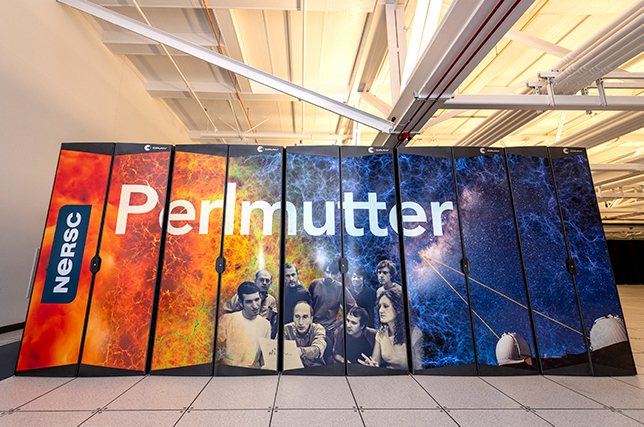
For the last two years, NERSC has been working with development teams to prepare codes for its latest supercomputer, Perlmutter, and the coming exascale systems. The NERSC Exascale Science Applications Program (NESAP) is a collaborative effort connecting code teams, vendors, and more. https://www.nersc.gov/news-publications/nersc-news/science-news/2021/berkeley-lab-targets-exascale-with-perlmutter-and-nesap/
X-Ray Experiments Reveal Skyrmion Secrets
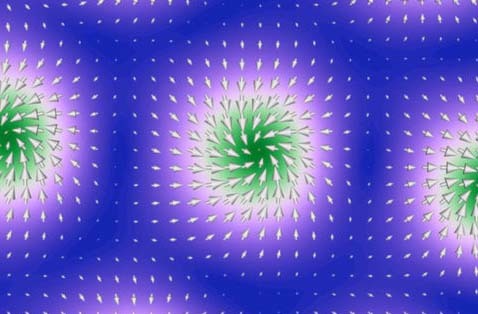
In recent papers, researchers from Berkeley Lab, SLAC, and UC San Diego suggest that skyrmions, magnetic vortexes that act like particles and move around independently, may have a lot in common with glass and high-temperature superconductors. https://newscenter.lbl.gov/2021/10/21/skyrmions-future-of-computing/
Physicists Snap First Image of an ‘Electron Ice’
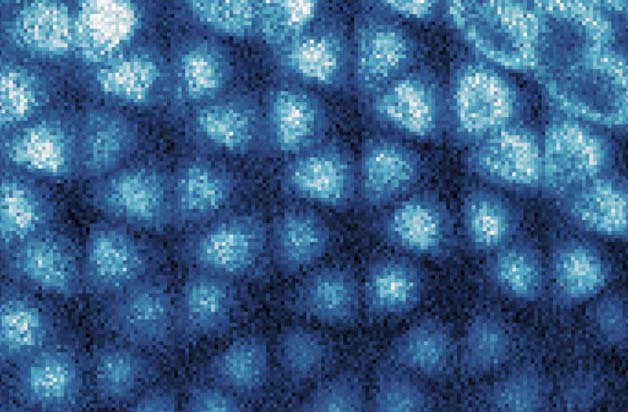
Physicists from the Lab and UC Berkeley recently published an image of electron ice sandwiched between two semiconductor layers in the journal Nature. The image is proof positive that these crystals, first predicted by physicist Eugene Wigner 90 years ago, exist. https://newscenter.lbl.gov/2021/10/21/first-image-of-electron-ice/
Spooky Science: Maxwell’s Demon
Maxwell’s Demon was born 154 years ago in the mind of James Clerk Maxwell who wanted to see if it was possible to violate the second law of thermodynamics. Could an imaginary demon serve as a trapdoor-keeper to direct fast or slow gas molecules to the correct chamber? https://sites.google.com/lbl.gov/weareberkeleylab/spooky-science/maxwells-demon
Spooky Science: Dark Matter
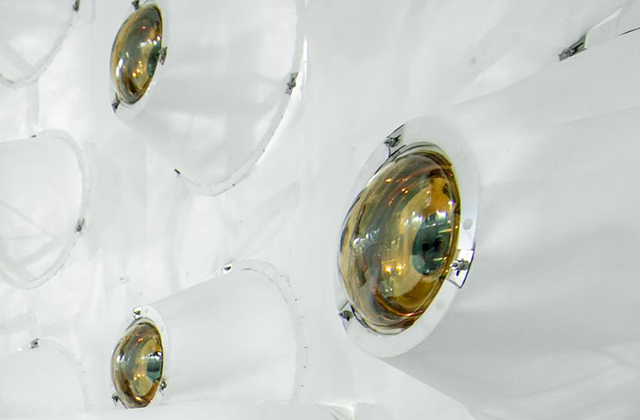
Several years ago, October 31 became more than just a day to hunt for free candy. It became the day to hunt for the origins of the universe. It is known as Dark Matter Day, and we celebrate by going deep underground to see how Lab researchers are looking for the unseen. https://sites.google.com/lbl.gov/weareberkeleylab/spooky-science/dark-matter
Spooky Science: Spooky Action at a Distance
Albert Einstein called it spooky action at a distance. He was right. This theory of quantum mechanics is spooky as two systems, even though separated by distance, both respond the same way at the same time. Spooky. https://sites.google.com/lbl.gov/weareberkeleylab/spooky-science/spooky-action
Spooky Science: Ghost Particles
Don’t look now, but the ghostly particles known as neutrinos are right behind you. And in front of you. And going through you. First proposed in 1930, these ghost particles are still puzzling researchers today. https://sites.google.com/lbl.gov/weareberkeleylab/spooky-science/ghosts
Listen to More Spooky Science
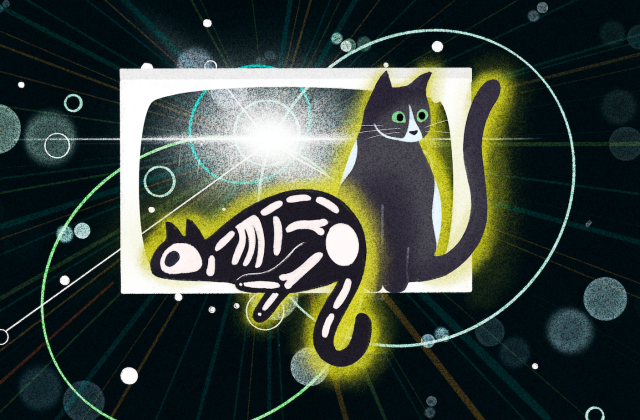
The Lab’s podcast series, A Day in the Half Life, hosted by Strategic Communication’s Aliyah Kovner, have several spooky podcasts perfect for listening with the lights out. Learn about dark energy with Nobel laureate Saul Perlmutter and Schrodinger’s Cat in an episode on quantum computing. https://newscenter.lbl.gov/a-day-in-the-half-life/