There may be a staggering amount of lithium underground at the Salton Sea, possibly enough to drive a domestic battery industry. First, scientists will figure out how much can be extracted sustainably. https://www.google.com/url?q=https://newscenter.lbl.gov/2022/02/16/quantifying-californias-lithium-valley-can-it-power-our-ev-revolution/&sa=D&source=calendar&ust=1645370670834889&usg=AOvVaw35Bwe67QnWqb4wwhDMLTyN
Home Energy Score Receives Federal Impact Award
The Home Energy Score™ software suite, co-developed by the Lab, was awarded the prestigious Federal Laboratory Consortium Impact Award for excellence in technology transfer achievement. The FLC award is one of the field’s top honors for federal laboratories and their industry partners. https://eta.lbl.gov/news/article/home-energy-score-receives-federal
Lab Scientists Play Key Roles in New Neutrino Milestone
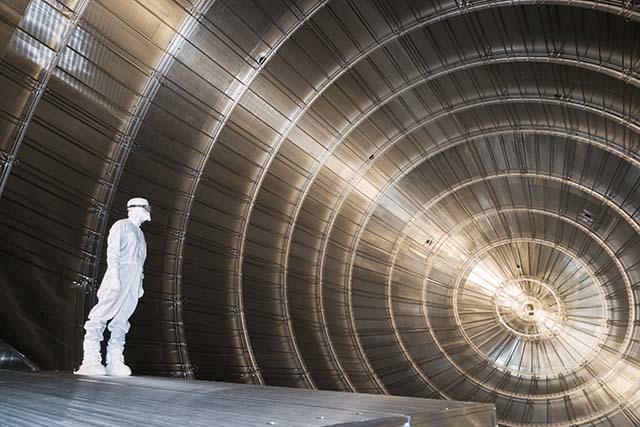
KATRIN, an international research team including Berkeley Lab scientists, has placed new limits on the mass of the neutrino — a particle so ethereal that trillions of them are passing through you as you read this. https://newscenter.lbl.gov/2022/02/14/berkeley-lab-researchers-computational-facilities-play-key-role-in-barrier-breaking-neutrino-mass-measurement/
Collaboration Charts New Course for Field Research Data
Field research is an essential tool in environmental science, but retrieving remote data and making it available for analysis are challenges. At the Surface Atmosphere Integrated Laboratory (SAIL) in Colorado, the Lab’s ESnet is helping to bridge those challenges. https://cs.lbl.gov/news-media/news/2022/esnet-connects-the-future-of-data-in-field-research/
Podcast: More Microchips, Moore Problems
Today’s microchips are awesomely tiny. The next challenges include making them more energy-efficient. Hear more about the future of microelectronics from the Lab’s Sinéad Griffin and Ramamoorthy Ramesh in the latest A Day in the Half-Life podcast from Strategic Communications. https://www.buzzsprout.com/1434640/10028704
Spectral Phenotyping for Early Alzheimer’s Disease Detection
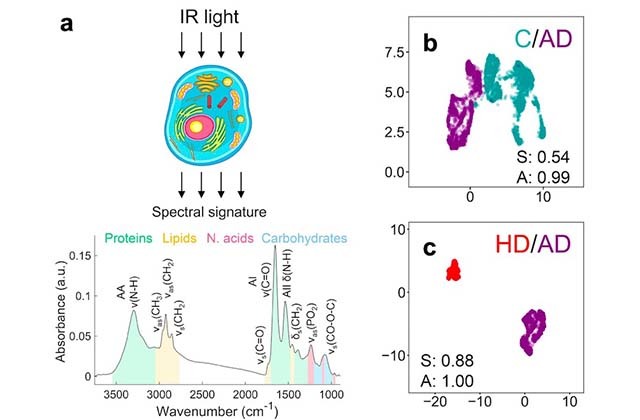
The most common cause of dementia is Alzheimer’s disease, but early detection has been difficult because Alzheimer’s comprises complex symptoms and genetic changes. A Lab team is now using a method called spectral phenotyping to detect the chemical signature of Alzheimer’s disease. https://als.lbl.gov/spectral-phenotyping-for-early-detection-of-alzheimers-disease/
Revealing Lithium Metal’s Electronic Structure
Spectroscopy at the Advanced Light Source and theoretical calculations at the Molecular Foundry revealed the intrinsic spectroscopic signature of lithium metal and explained the origin of previous contradictory reports. https://als.lbl.gov/revealing-lithium-metals-electronic-structure/
New Optical Material Assembles Itself
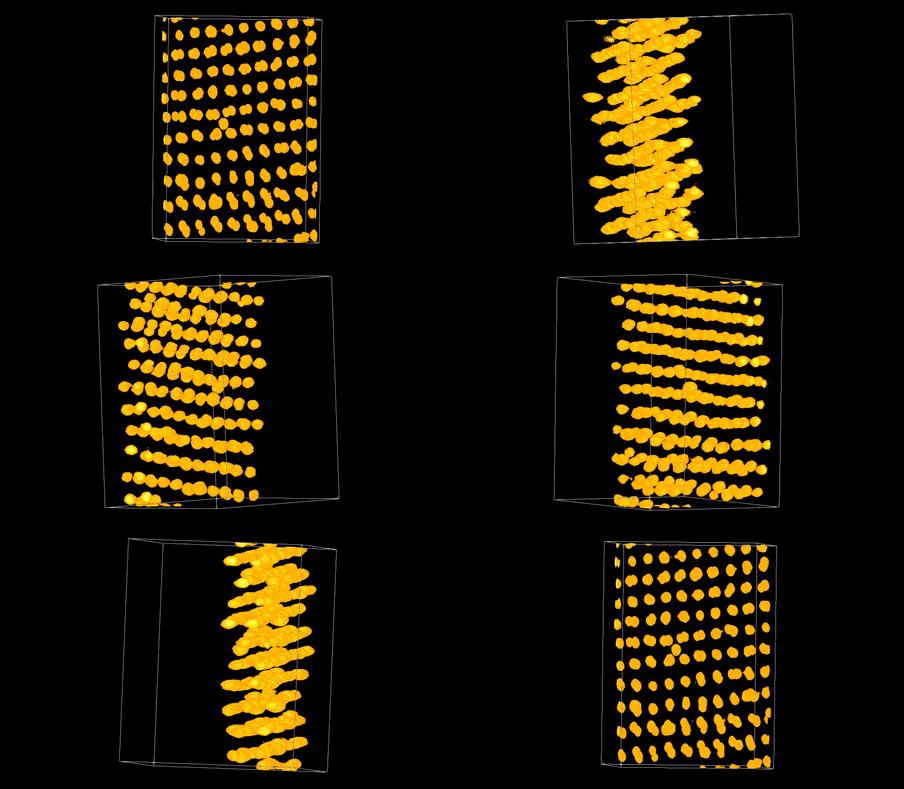
A team led by Berkeley Lab researchers has demonstrated an optical material that self-assembles from tiny concentric nanocircles. Their work could enable the large-scale manufacturing of nanocomposites for fiber-optics telecommunications systems as well as for buildings, automobiles, and aerospace. https://newscenter.lbl.gov/2022/02/04/optical-material-assembles-itself/
Modeling Cell-by-Cell Spread of Respiratory Infections
Lab scientist Steve Hofmeyr and a team at the University of New Mexico and Arizona State University used the Cori supercomputer to model how COVID-19 and other viral infections spread in the lungs, capturing a cell-by-cell process as it’s never been captured before. https://cs.lbl.gov/news-media/news/2022/simcov-models-cell-by-cell-spread-of-respiratory-infections/
How Shark Egg Cases Balance Toughness and Permeability
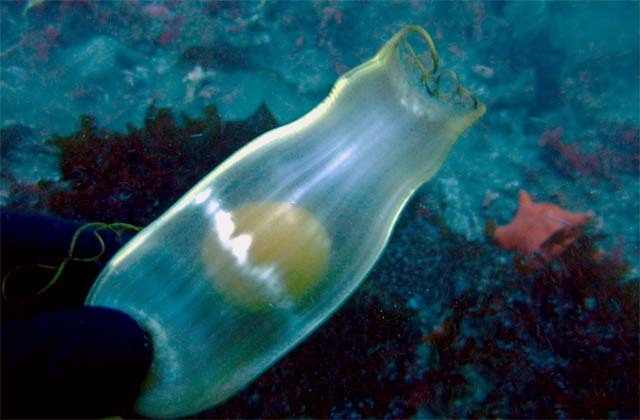
Researchers from UC Santa Barbara, Duke University, and the ALS are using the ALS’ capabilities to study tough yet permeable shark eggs. Shark egg cases evolved to withstand relentless ocean conditions, and insights into their nanoarchitecture could advance the development of synthetic materials. https://als.lbl.gov/how-shark-egg-cases-balance-toughness-and-permeability/